16 October 2011

Mere Hypocrisy

One of the incisive graphics that circulated on the Internet recently is a photograph titled, sarcastically, “Down with Evil Corporations.” The photo vividly illustrates the irony of an “Occupy Wall Street” mob shouting their protests of capitalism . . . all while using the products of the very capitalism they denounce.


It is perfectly valid to shine a light upon the ignorance and hypocrisy of the anti-capitalist crowd, and images like the one above are excellent concrete encapsulations of the protesters’ sheep-like innocence of facts and historical context. But in doing so it is important to keep in mind that there are deeper issues at stake than mere hypocrisy.

The reason I point this out is that on the surface, this common-sense criticism of the “Occupy Wall Street” mobs might seem to share ground with another famous (or infamous) argument that made the rounds on the Internet recently: Elizabeth Warren’s quote, “There is nobody in this country who got rich on his own, etc.” 
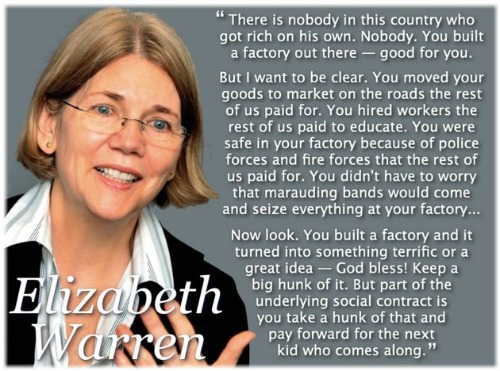


Image from BookWormRoom.com.

Superficially, these arguments may seem similar. The anti-capitalists have no grounds to criticize capitalism while snapping photographs with Sony cameras, shaving with Gillette razors, and wearing clothes from The Gap. In turn, capitalists have no grounds to criticize the government and high taxes while using public roads to transport goods, hiring workers educated in public schools, and feeling safe in their factories because of police protection. (Actually, Warren’s argument goes much further than merely accusing the rich of criticizing the government; her explicit goal is to seize a “big hunk” of producers’ wealth.) Both arguments amount to the idea that it is improper to simultaneously benefit from and complain about some condition or institution. 

However, to unite these two arguments would be a logical error; it would constitute an attempt to integrate concretes by non-essentials. When generalizing, it is necessary to apply the mental process of abstraction--but in doing so, one must not focus on non-essential attributes at the cost of fundamental principles. The mistake that would be made in attempting to unite Warren’s criticism of businessmen with that of bloggers’ and pundits’ criticisms of the “Occupy Wall Street” protesters is to gloss over the content of those criticisms. 

The fundamental principle here is force. The "Occupy Wall Street" demonstrators voluntarily use the fruits of a free society to complain about that free society. Under capitalism, nobody--including Google, Apple, IBM, Proctor & Gamble, Exxon-Mobil, Alcoa, DuPont, Hewlett Packard, 3M, Abercrombie & Fitch, WalMart, the local supermarket, barbershop, bodega, plumber, service station, or lemonade stand--can force you to use their products. The only way they can obtain your business is by offering you value--a value that you judged to be greater than the money you paid for it. No matter how much one believes big companies to have the “upper hand” over the “little guy,” it is not force.  On the contrary, the more the products of “Big Oil,” “Big Pharma,” “Big Food,” etc. are recognized to be vital human needs, the more crucial it is to identify the political freedom that makes such voluntary transactions possible. 

In contrast, a government by its very nature can only apply force. It is all they do. Force is the raison d’etre of governments; compulsion is all they bring to the table. When government force is used appropriately (i.e. in a retaliatory manner) via the police, armed forces, and court system, it serves to safeguard individual rights. When government force is used inappropriately (i.e. in an initiated manner), which includes any and all intrusions into the economy, education, and morality, it violates individual rights.

The first thing to be observed about Warren’s comment is that she conjoins proper (e.g. police) and improper (e.g. roads and education) functions of government without distinguishing between the two. But the point most relevant to this discussion is Warren’s accusation that the wealthy use government services without paying for them. (She had the brazen mendacity to say “the rest of us” paid for roads, education, etc., when in fact the wealthiest citizens shoulder the biggest tax load by far.) This disregards the fact that such “services” are forced upon all of us. Productive citizens are compelled to pay for government programs whether they like it or not.

Elizabeth Warren’s argument amounts to using the fact that the wealthy were forced to use the “services” of an intrusive government in the past as a pretext to force them to pay for still more government intrusions. These new “services,” being ever more difficult to avoid, serve as justification for the next generation of government intrusions, and so on. Ms. Warren’s declaration follows, in all relevant aspects, the form of a protection racket. Whether or not the self-righteous and thuggish manner with which she delivered it also follows the style of a protection racket may be judged by observing her performance directly.[1]

Those who condemn the “Occupy Wall Street” mob for their hatred of capitalism are right for the same reason that Elizabeth Warren is wrong. The fundamental issue is not mere hypocrisy but political liberty, of which Warren is an explicit enemy and most members of the mob are unthinking antagonists.


NOTES

1. See the YouTube video, “Elizabeth Warren on Fair Taxation,” http://www.youtube.com/watch?v=hOyDR2b71ag.

22 September 2011

An Interesting Omission

In a brief post called "Presidential Plagiarist?" Ira Stoll was sharp enough to notice that in Barack Obama's "jobs speech," the president made a point that he pretty clearly took from the new book by Thomas Friedman and Michael Mandelbaum without giving any attribution to the authors. Now, considering that Mr. Obama is hell bent on destroying our country and the future of Americans, plagiarism is far from the greatest of his offenses, but what caught my eye is what the president did not lift from the passage.

Stoll quotes a paragraph from That Used to Be Us: How America Fell Behind in the World It invented and How We Can Come Back, in which Friedman and Mandelbaum make the following basic argument. (Below, I am paraphrasing and condensing the authors' statement to clarify the point I am going to make.)[1]

President Lincoln's administration passed several pieces of legislation to spur the transition from an agragrian to an industrial society:(1) the Homestead Act of 1862,(2) legislation related to the transcontinental railway,(3) the creation of the National Academy of Sciences, and(4) the establishment of land grant colleges.

In his speech, the President made nearly the identical statement. (Again, I am paraphrasing.)

President Lincoln's administration passed several pieces of legislation to spur the transition from an agragrian to an industrial society:(1) legislation related to the transcontinental railway,(2) the creation of the National Academy of Sciences, and(3) the establishment of land grant colleges.


Do you notice anything missing in the president's speech? Mr. Obama conspicuously dropped the Homestead Act from the items that Friedman and Mandelbaum had listed. Interesting, is it not? The Homestead Act is the one piece of legislation out of the four Friedman and Mandelbaum mentioned that does not constitute government meddling in the economy, science, or education--and Mr. Obama left it out.[2]
  
I can think of only two reasons why the president may have done so. Either he simply forgot it, being unable to mentally grasp or retain any freedom-respecting policies like the Homestead Act, or he deliberately omitted it because in his worldview, the purpose of government is to command and control individuals, not to set them free. Either way, it is interesting to see that Mr. Obama can't even get something right when he is copying others' work.


NOTES

1. Ira Stoll, "Presidential Plagiarist?", Future of Capitalism, September 8, 2011, http://www.futureofcapitalism.com/2011/09/presidential-plagiarist.

2. The Homestead Act is a good example of government functioning properly.
In her essay, "The Property Status of Airwaves," Ayn Rand wrote, "A notable example of the proper method of establishing private ownership from scratch, in a previously ownerless area, is the Homestead Act of 1862, by which the government opened the western frontier for settlement and turned 'public land' over to private owners. The government offered a 160-acre farm to any adult citizen who would settle on it and cultivate it for five years, after which it would become his property. Although that land was originally regarded, in law, as 'public property,' the method of its allocation, in fact, followed the proper principle (in fact, but not in explicit ideological intention). The citizens did not have to pay the government as if it were an owner; ownership began with them, and they earned it by the method which is the source and root of the concept of 'property': by working on unused material resources, by turning a wilderness into a civilized settlement. Thus, the government, in this case, was acting not as the owner but as the custodian of ownerless resources who defines objectively impartial rules by which potential owners may acquire them.

This should have been the principle and pattern of the allocation of broadcasting frequencies." 

From Capitalism: The Unknown Ideal (New York: Signet, 1967), p. 124.


15 September 2011

Attack Watch

I've seen some good responses from Americans who are not cowed by the latest snitch line that was established by Obama's minions--the "Obama for America" website, AttackWatch.

My favorite was from my wife:

Dear @attackwatch, I'd like report Reality and History: Both rail against Obama's central planning efforts. You should check them out.


12 September 2011

Faith and Sacrifice

In his recent Forbes article, Richard Salsman made an excellent point that I wish I had thought of when I was writing my last post. On the subject of the September 11 attacks, he wrote:

While 9/11 also exhibited the evils of religion, most U.S. politicians and citizens responded by becoming still more religious. Most people also extol the alleged "self-sacrifice" of "first responders," not realizing how that dishonors the responders' love of life and liberty -- and implies that the suicidal jihadist-hijackers also were morally noble.[1]

That is quite true. To remain logically consistent, those who extol faith and sacrifice would have to reserve special praise for the terrorists themselves, who exemplify faith and sacrifice far more than do the civilized innocents and heroes that they murdered. It is under the banners of faith and sacrifice, in both religious and secular forms, that the worst horrors of history have been perpetrated.

With all respect and sympathy for the family members and friends of the victims, who have endured unimaginable pain, turning toward religion in the mourning of loved ones serves the interests of their killers. Seeking succor in God--seeking everything in God--and rejecting reason is precisely what Islam demands.


NOTES

1. Richard M. Salsman, "Why Washington Resists Victory in a Post-9/11 World," Forbes, Spetember 11, 2011, http://www.forbes.com/sites/richardsalsman/2011/09/11/why-washington-resists-victory-in-a-post-911-world/.